
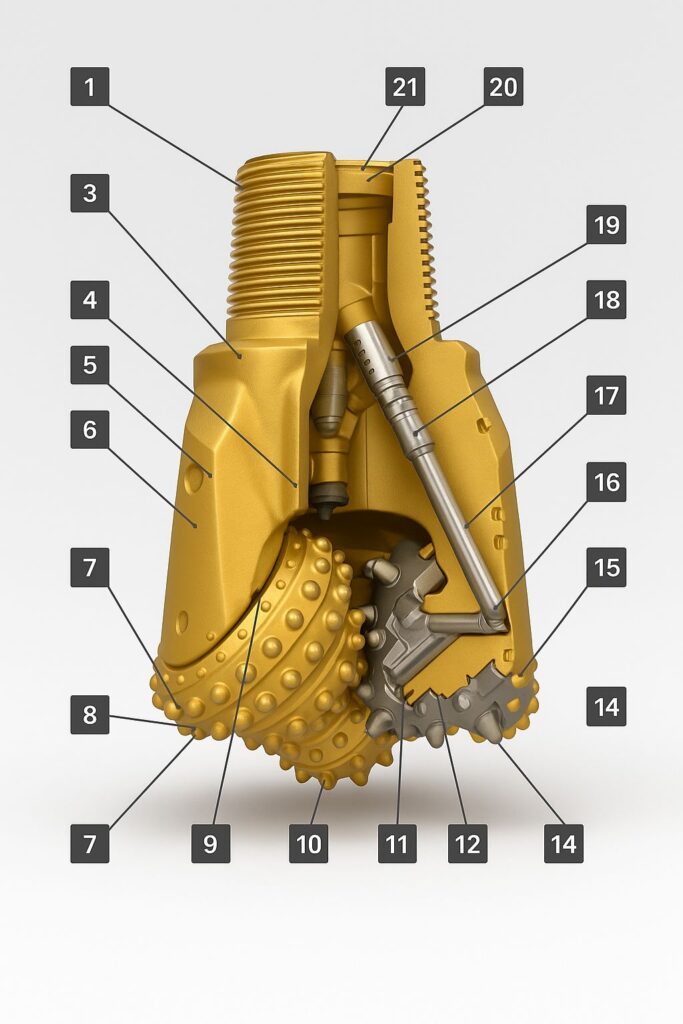
Whether you’re drilling for water, minerals, or hydrocarbons, the drill bit is the unsung hero beneath the surface. It’s the cutting tool at the end of the drill string that breaks, cuts, or crushes the rock to form a borehole.
In oil and gas, the most common bit is the Tricone Bit (like the one shown here), equipped with multiple cones and teeth to handle tough rock formations. Let’s break down its key components
Drill Bit Components & Functions (Simplified):
- Connecting Thread – Like a screw cap, it attaches the bit to the drill string.
- Thrust End Connection Thread – Ensures a tight, strong connection to transfer force.
- Nozzle Fixation – Holds the nozzles in place that direct air or mud to cool and clean.
- Paw – Structural support element for the cone.
- Surfaced Leading Edge – First point of contact, designed to resist wear.
- Claw on Reverse Cone Cutters – Helps grip and break hard rock.
- Calibrating Row Tooth Cutters – Shapes the hole to the desired gauge.
- Cone Body – The main rotating part that holds the cutting teeth.
- Air Outlet Groove – Path for air/mud to exit, cleaning the cutting area.
- Top Cone Tooth – The “teeth” that crush rock—like the molars in your mouth.
- Thrust Bearing Slip – Absorbs downward force to reduce friction.
- Inner Roller Bearing – Lets the cone spin smoothly, like a bicycle wheel hub.
- Ball Bearing – Prevents wobble and ensures rotational balance.
- Outer Roller Bearing – Supports external cone movement under heavy load.
- Surfaced Paw Visor – Protects internal parts from wear and debris.
- Locking Finger – Holds the internal parts in position.
- Air Purge Channel – Directs compressed air to remove rock cuttings.
- Nozzle – Like a jet spray, it cools the bit and clears debris.
- Air Channel Filter – Filters out dust/debris from the airflow.
- Check Valve – Prevents reverse flow—like a one-way street.
- Retaining Ring – Locks everything in place to keep it all running safely.
Fun Fact: The three cones in a tricone bit rotate independently, allowing the bit to grind through rock like a set of gears chipping away at the earth.
Whether you’re a drilling engineer or just curious, understanding this marvel of engineering helps appreciate the complexity and innovation beneath every well drilled.
Swipe through the diagrams to get a visual understanding of each part (check the carousel)